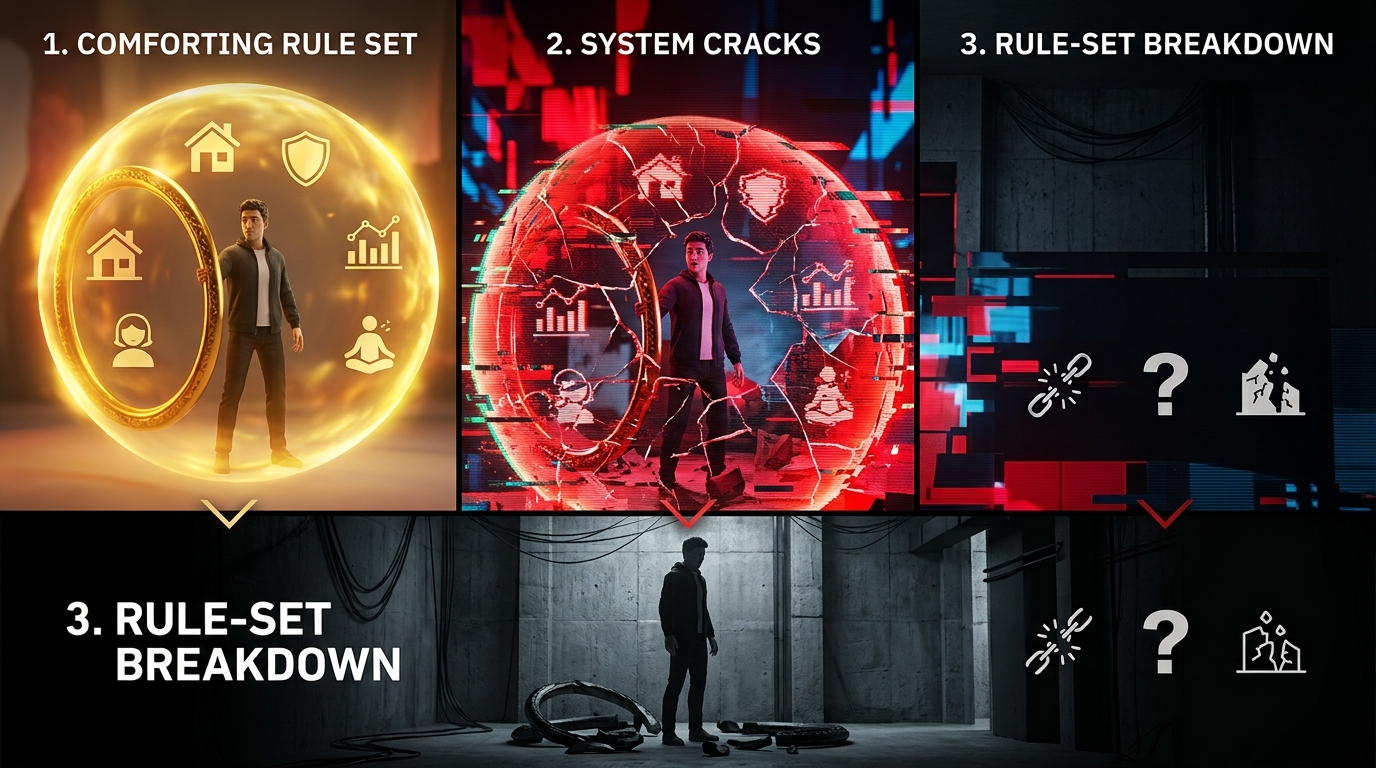
In traditional media, a plot twist occurs when new information is revealed to the audience — a sudden reveal in a script or a sudden dialogue confession. In video games, however, the most haunting and emotionally resonant twists do not occur in cutscenes. They happen when the rules of the game themselves collapse — a structural phenomenon known in narrative design as a Rule-Set Breakdown.
Game mechanics act as a contract of meaning between the developer and the player. When a mechanic is given to the player — such as an item, a vision toggle, or an environmental manipulation system — it is initially presented as a tool of agency, safety, or progress.
Phase 1
Comforting Rule Set
Player feels in control
Mechanic: Ring / Item alters perception or environment on demand.
Phase 2
System Cracks
Subtle inconsistency
Mechanic: World response lags; minor perceptual mismatches occur.
Phase 3
Rule-Set Breakdown
Denial collapses
Mechanic: The system fails to protect or alter the world; reality locks in place.
Mechanics as Defense Systems
In psychological and guilt-driven narratives, player mechanics often represent psychological defense mechanisms. Consider a core gameplay loop where a character uses a specific object (e.g., a ring or a temporal switch) to transition between two states of a world (Day/Night or Reality/Perception):
The player uses this mechanic to solve puzzles, navigate blocked paths, and bypass danger. They come to rely on it as their primary tool for safety.
In truth, the mechanic does not alter the physical world; it represents the protagonist's active denial — an internal coping strategy to flee from a traumatic reality.
The Mechanical Collapse
A standard narrative design flaw is allowing the player to retain mechanical control right up until a cutscene abruptly explains the truth. A true Rule-Set Breakdown integrates the reveal directly into the player's hands:
- Failure of Response. When the protagonist reaches the emotional threshold (the climax), the player attempts to invoke their trusted mechanic to escape the approaching truth.
- System Refusal. The mechanic fails. The input no longer alters the environment, the camera locks, or the perception layer strips away, forcing the player to remain in the unvarnished reality.
- The Epistemological Shift. The player realizes that their primary tool was never a superpower or a solution — it was a vessel of escape.
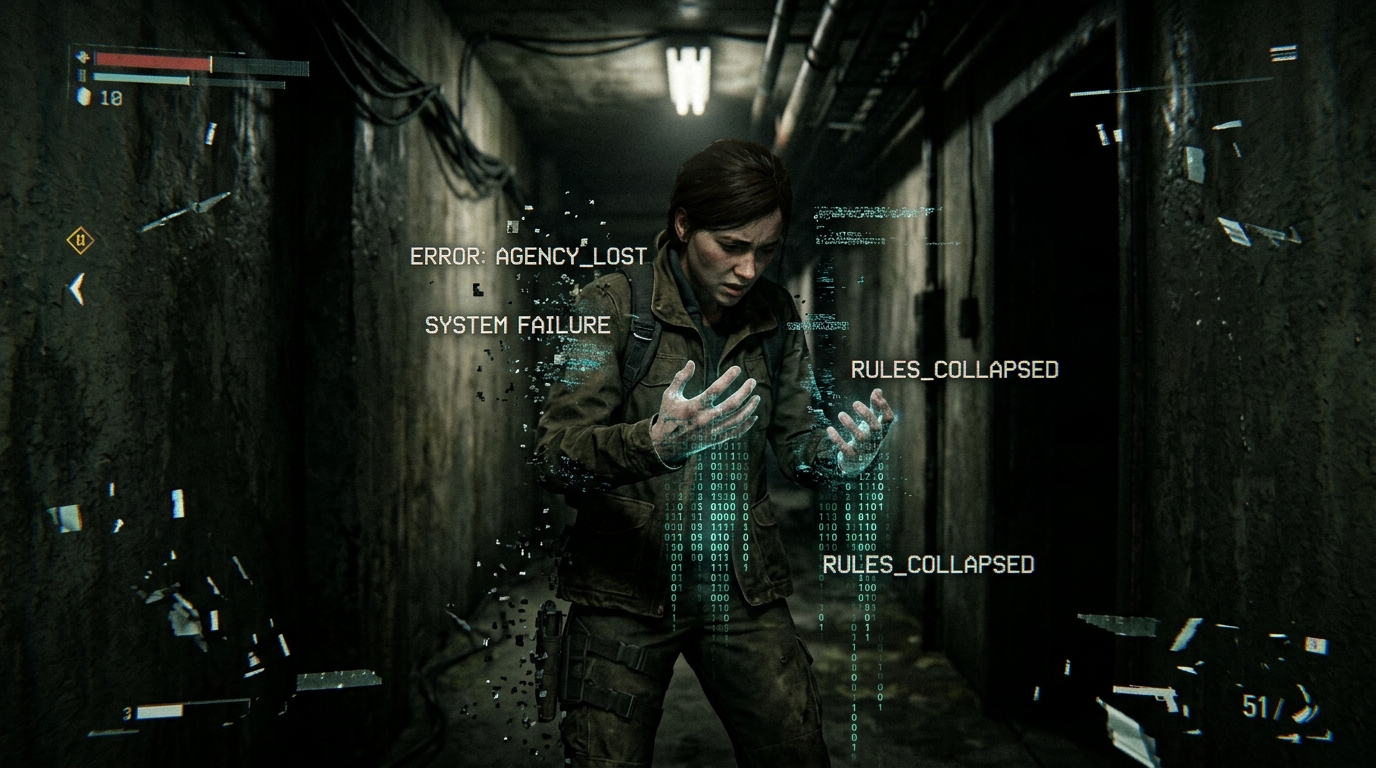
When a game mechanic stops protecting the player, they are deprived of their agency at the exact moment their character's denial shatters.
This transforms a simple plot reveal into a mechanical betrayal, forcing the player to share the protagonist's exact vulnerability and loss of control.